
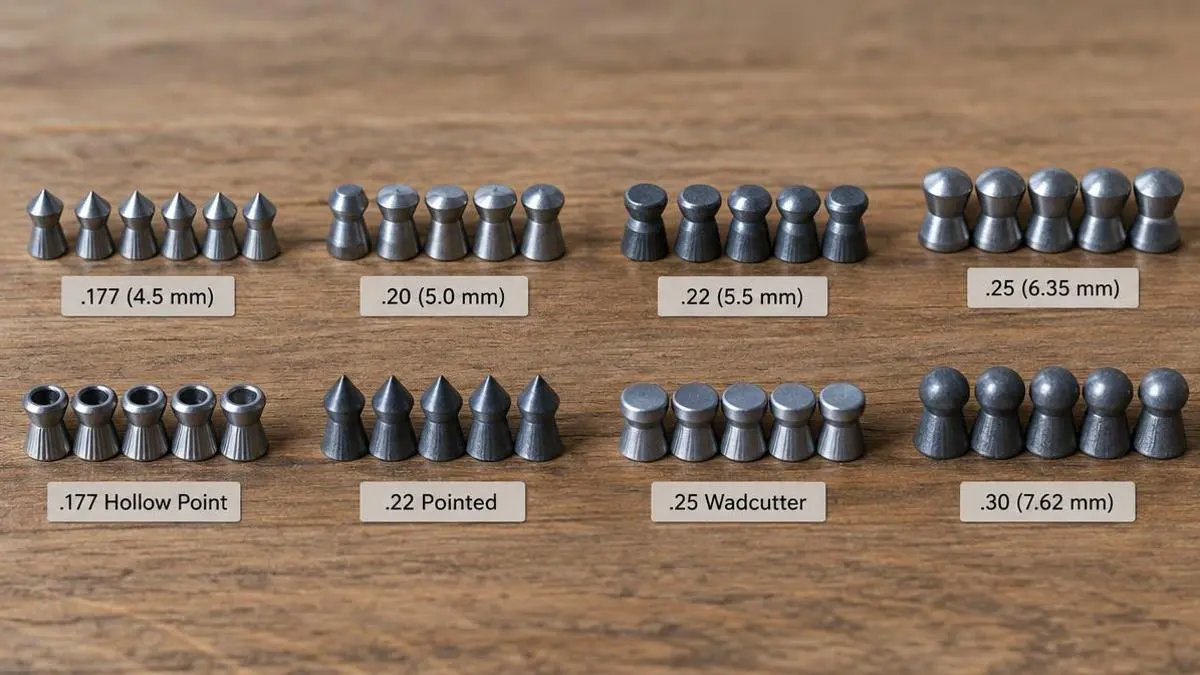
A pellet that groups neatly one day can scatter the next, even when the sights and shooting position look exactly the same. I have noticed that a pellet can group well one day and scatter the next. That can be frustrating. The reason for this change is often something people overlook: how well the ammunition fits the airgun. The calibre may be correct, but the weight or shape of the pellet might not match the barrel or the power system. Calibre gives you a starting point; it does not tell the whole story. To get results, you must consider diameter, weight and shape as connected choices, then test them through shooting.
Calibre is the diameter starting point
Calibre means the diameter of the projectile, usually measured in inches. Common airgun calibres include .177 and .22. Other sizes exist for different types of airgun. The number tells you the size of the pellet, but not everything about how it will behave. Calibre does not guarantee that every pellet in that calibre fits every barrel properly.
A pellet must fit the barrel correctly
A pellet must fit the barrel correctly. The pellet needs to engage the rifling to spin properly and leave the barrel consistently. It should load without much effort. If the pellet is too loose, air can slip past it and the pellet may not stabilise. If it is too tight, loading becomes hard and the airgun may not shoot efficiently. Even small differences between brands, designs and barrels mean that nominal calibre is best seen as a starting point, not an answer.
Start with the airgun's manual
The first step is simple: read the airgun's manual. Use the calibre the manufacturer recommends. Never try to use a calibre just because it looks close. A labelled tin can help you identify the ammunition. The physical condition of the pellets matters too. Bent skirts, damaged heads or debris can cause flyers that look like a sight problem.
Diameter changes more than point of impact
Pellet diameter affects how well the pellet seals against the barrel. That seal controls how efficiently compressed air or gas pushes the pellet forwards. I have seen that the seal matters for group size. It also affects how consistently the pellet contacts the rifling, which influences stability and group size.
There is a trade-off. A lighter, smaller-calibre pellet may reach a target faster. That can be convenient for shooting at paper targets. A larger-calibre pellet often carries more mass. Neither is better in every case. The airgun's power system, the barrel, the intended distance and the type of target all matter.
Do not judge a diameter based on one shot or one damaged target. Shoot from a rest. Make sure the sights are secure. Compare groups, not individual hits. If the group changes dramatically between tins of the labelled calibre, the difference may come from fit, shape, weight or manufacturing consistency, not the calibre number itself.
Pellet weight affects speed and retained energy
Pellet weight changes the balance between velocity and momentum. In an airgun, a heavier pellet behaves differently from a lighter one. The heavier pellet may leave the muzzle more slowly, but it can retain useful energy farther downrange because more mass resists air drag. I have tried different weights and seen how speed changes. The exact result depends on the gun, pellet design and conditions. Weight alone cannot tell you the energy at the target.
A light pellet can be appealing when a flat trajectory and easy handling are priorities. A heavier pellet may be a match for a rifle that produces enough power to drive it consistently, especially when the target is farther away or a little more resistance to wind is useful. The trade-off is speed: a heavy pellet can produce a different point of impact and may require a different sight setting.
Look for consistency rather than the highest advertised velocity. Chronograph figures, when available from the instructions or careful measurement, are part of the picture. Downrange energy is what remains at the target. That energy is affected by velocity loss, pellet shape and environmental conditions. Use the manufacturer's guidance. Do not assume that a heavier pellet is automatically safer, more accurate or more powerful in every setup.
Shape determines how the pellet meets the air
Pellet shape influences both flight and what happens when the pellet reaches paper or another suitable target. I prefer wadcutters for paper targets because they score cleanly. Wadcutters have a nose that cuts clean holes in paper, making them easy to score. Rounded or domed designs often offer a balance for target work. Pointed designs may appear aerodynamic, but appearance is not a substitute for a good fit and stable flight.
Skirt shape matters too. The thin part at the back of the pellet helps it seal the barrel. The pellet may change shape as it moves forwards. A damaged skirt can make the pellet go faster or slower and can leave a trail. Keep the tins closed. Avoid handling pellets unless necessary. Check ammunition that has been kept in a place where it could have been damaged.
Pick the shape that fits the task. For close-range paper targets, clean scoring holes may matter more than how the pellet flies. For shooting at a range, a pellet that groups together neatly in a particular airgun is usually more useful than one that looks sleek but does not perform. Test one change at a time so you can see whether the difference comes from shape, weight or shooting technique.
A practical way to match pellets to an airgun
Begin with the manual's calibre and ammunition advice. Then choose good pellet designs in that calibre, keeping the test controlled. Use the same distance, rest, target size, sight setting and shooting routine for each pellet. Let the barrel and equipment stay in the condition that the manufacturer recommends, avoiding overly vigorous cleaning or changes to parts while you compare.
Write down the group size, point of impact, how the pellet loads and any damaged pellets. A pellet that loads smoothly, makes a consistent group and lands in a sensible place is a better choice than one that gives you a single great shot. If the pellet needs force to seat, falls loosely into the airgun or shows repeated damage, stop using it and check the manual or ask a qualified airgun technician.
Use a backstop that can contain the pellets safely. Check what is behind the backstop before you shoot. Wear eye protection. Keep the airgun's muzzle pointed in a safe direction. Treat every airgun as loaded until you have checked it yourself. Follow the rules for where you may shoot. Never rely on a pellet's calibre or weight instead of careful handling.
The best match is usually the pellet that fits well, makes consistent groups and has the right energy for the target you want. The calibre limits the choices. Careful observation helps you decide.