
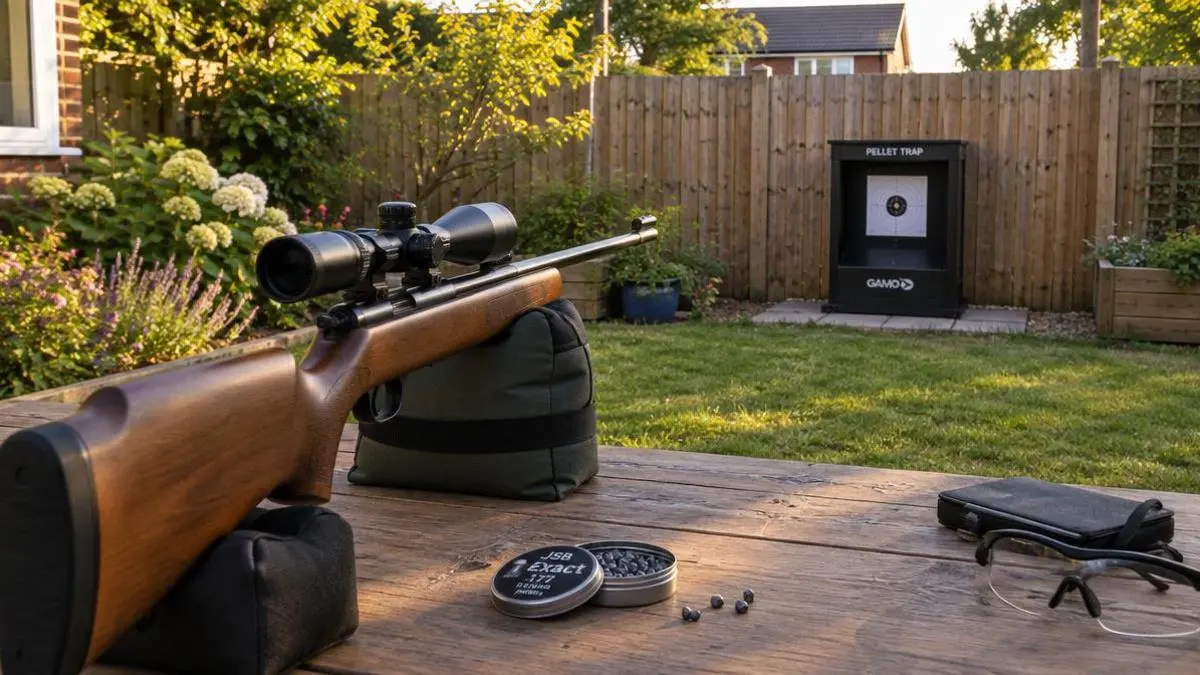
A small yard can be a useful place to practise shooting, but convenience fades quickly when pellets go where they should not. Loud noise can disturb neighbours, while equipment that is difficult to handle makes things worse. The best choice for backyard target shooting is usually a quiet pellet gun suited to a properly contained range. It is not about choosing the most powerful model. The real question is which setup lets you practise safely, consistently and with consideration for others.
Start with the yard, not the catalogue
Before looking at guns or power systems, examine the space you plan to use. Identify the direction in which you will shoot and the backstop available. Think about every place a pellet could go if it misses, passes through the target or strikes a surface. Windows, walkways, sheds, neighbouring gardens and public areas all need attention before you load an airgun.
Space also affects the kind of practice that is suitable. A small yard might be enough for paper targets at a clearly marked distance. A longer garden could accommodate a structured target frame. Neither situation means you need a gun with extra power. Greater power brings more noise, deeper penetration, greater ricochet risks and a backstop that must be built with care.
Check the rules before setting up. Restrictions can apply to airguns, discharging, property lines, noise disturbance or where shooting is permitted. Always follow the manufacturer's instructions for loading, cocking, handling and storing the airgun.
What makes an airgun suitable for practice
For many home ranges, a low-power airgun is easier to manage than a high-output rifle. It reduces the demands on the backstop and makes short-range work less disruptive. That does not mean it is harmless. Even a modest pellet gun can injure someone, damage property or bounce off a surface.
Quiet pellet guns are not silent. The mechanical sound, the pellet striking the target and the noise it makes when hitting the backstop can all be heard. A spring-powered rifle may produce a snap, while a pneumatic or CO2 gun may have its own sound and feel. Each system involves trade-offs in weight, preparation, consistency, sensitivity to temperature, maintenance and cost. Choose the system that fits your routine, rather than assuming one type is best for every yard.
An air rifle usually provides an aiming platform and a longer sight line. An air pistol takes up less space, but makes stance and trigger control more challenging. Whichever you choose, look for controls, a comfortable grip or stock, sights that are easy to see in the available light and a trigger that can be pulled without moving the muzzle.
Do not choose a gun simply because it is described as more powerful. For target practice, easy handling and consistent accuracy are more useful than range you cannot safely use.
Build the setup around containment
The backstop is the heart of the range, not something to add later. Use a pellet trap made for the job, or a strong, properly placed stopping system that can catch both direct hits and missed shots. Read its instructions and check it frequently. Repair or replace it if pellets begin to pass through.
Place the paper target so that it sits securely against the backstop. Do not use a sheet, a flimsy box or a soft garden item to stop pellets. Avoid flat surfaces that might send pellets bouncing back unpredictably. If the target frame can tip, secure it. If wind can move it, account for that before you begin shooting.
A practical setup also includes a shooting position, good lighting and a safe place to put the unloaded airgun between shots. Keep the target at a distance where you can see the holes without rushing your aim. A simple printed bullseye is often enough; using the same target size and placement makes changes in grouping easier to see.
Before each session, check that:
– the shooting direction is clear and the backstop is still in place;
– there is no damage or loose pellet in the trap, target holder or nearby ground;
– no one, including pets, can enter the range from behind or the sides;
– eye protection is ready, and pellets are in a container that prevents spills or mixing; and
– you know where the airgun will be unloaded and stored when practice ends.
Never alter the airgun to make it more powerful or to bypass safety features. Unauthorised changes can affect how it handles, reduce reliability, alter its status and make the original instructions less useful.
Keep people out of the line of fire
A neighbour-friendly range is quiet, predictable and easy to explain. Shoot during reasonable hours and keep sessions controlled. Do not place the target where the direction of the muzzle, or your movements, might worry people nearby. Even when shooting is allowed, local expectations about noise and visible shooting may be stricter than the minimum requirements.
Tell household members when the range is active. Make a clear rule: no one enters the shooting area until the airgun is unloaded, made safe and put down. If someone enters by mistake, keep the muzzle pointed in a safe direction, stop handling the gun and wait until the range is clear.
Never fire pellets at glass, metal, stones, water, animals or improvised targets. Ricochets are difficult to predict, and a target that looks safe at one distance can become dangerous with repeated hits. Keep the airgun pointed in a safe direction during loading, and follow the manual on whether to cock or load before firing.
Storage matters after practice. Unload the airgun as the instructions require, keep it secured from access and store pellets separately where children cannot reach them. Treat the equipment as dangerous even when it appears to be unloaded.
Make consistency the goal
Backyard practice is not about shooting quickly. It is about learning how changes affect your grouping. Use a consistent stance and grip, maintain the sight picture and focus on a smooth trigger press rather than pulling the gun towards the target at the last second.
If your groups suddenly spread out, stop and check the basics before changing the sights. Look for a loose sight or stock screw, and check whether the target is damaged. Consider whether your position has changed, whether pellets are loose or whether the backstop is moving. Lubricate only as the manufacturer advises. Too much oil, or the wrong type, can cause problems, while some airguns need very little routine maintenance.
Keep a record of the airgun, pellet type, target distance and conditions. This need not become a study. A few notes can show whether a change actually helped or whether a good group was simply luck.
The best pellet gun for home practice is the one that fits the space, can be contained safely and encourages repetition. Start with a setup that works. Check the rules and the instructions. Let good target practice grow from sound habits, not unnecessary power.